
Case Studies: Top Indian Projects Where GRC and FRP Transformed Architecture
Indian architecture is rapidly evolving, blending innovation, aesthetics, and performance. GRC (Glassfiber Reinforced Concrete) and FRP (Fiber Reinforced Polymer) have emerged as key materials enabling this transformation. From commercial developments to public infrastructure, these materials have helped architects achieve complex designs while meeting structural and functional demands.
Below are notable project-based case studies showcasing how GRC and FRP have reshaped architectural outcomes across India—without referencing any specific companies.
1. Commercial Complex Façades with Complex Geometry
Material Used: GRC
Architectural Challenge:
Designing visually striking façades with intricate patterns, curves, and textures while keeping structural loads under control.
GRC Solution:
GRC panels were used to create lightweight façade systems capable of supporting detailed geometry, sharp edges, and sculptural forms that traditional concrete could not easily achieve.
Impact:
- Strong architectural identity
- Reduced dead load on the structure
- Faster installation and precision detailing
- Long-term weather and crack resistance
2. Public Infrastructure & Transit-Oriented Structures
Material Used: GRC and FRP
Architectural Challenge:
High-usage public structures required materials that combined durability, safety, and modern aesthetics with minimal maintenance.
Material Application:
- GRC for wall cladding, ceilings, and decorative panels
- FRP for canopies, skylights, and curved roofing elements
Impact:
- Enhanced visual appeal of public spaces
- Improved resistance to moisture, pollution, and corrosion
- Lightweight components reduced structural stress
- Longer service life with lower upkeep costs
3. High-Rise Residential & Mixed-Use Buildings
Material Used: GRC
Architectural Challenge:
Creating premium exterior detailing at height without adding excessive weight or compromising installation safety.
GRC Solution:
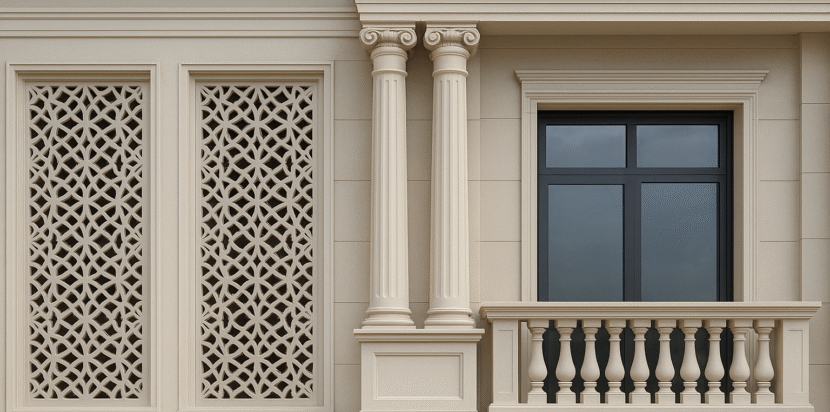
GRC mouldings, screens, balcony features, and façade accents were incorporated to deliver luxury aesthetics with lightweight construction.
Impact:
- Elegant, consistent exterior finishes
- Safer and quicker installation at upper levels
- Reduced load on the building framework
- Improved thermal and acoustic comfort
4. Cultural & Institutional Architecture
Material Used: FRP
Architectural Challenge:
Designing expressive, symbolic forms requiring flexibility, creativity, and structural efficiency.
FRP Solution:
FRP was used to create free-form shapes, domes, shading elements, and artistic installations that demanded precision and curvature.
Impact:
- Freedom to explore organic and complex designs
- High resistance to weathering and corrosion
- Lightweight structures with strong load-bearing capacity
- Reduced construction time for custom forms
5. Industrial & Utility Structures
Material Used: FRP
Architectural Challenge:
Structures exposed to harsh environments required materials capable of withstanding chemicals, moisture, and heavy usage.
FRP Solution:
FRP gratings, panels, covers, and enclosures were used due to their excellent chemical resistance and durability.
Impact:
- Enhanced safety and longevity
- Minimal maintenance requirements
- Improved operational efficiency
- Cost-effective performance over the long term
The Growing Role of GRC and FRP in Modern Architecture
Across diverse project types, GRC and FRP have consistently delivered:
- Greater design flexibility
- Lightweight construction advantages
- High durability and weather resistance
- Long-term cost efficiency
- Support for sustainable building practices
As architectural demands continue to evolve, GRC and FRP are proving essential in creating structures that are innovative, resilient, and future-ready.
Why Stone King Enterprises is a Preferred Choice for GRC & FRP Solutions
🔹 Well-Established Specialist in GRC & FRP
Stone King Enterprises has built a strong reputation in the architectural materials space, specializing in GRC (Glassfiber Reinforced Concrete) and FRP (Fiber Reinforced Polymer) products such as jalis, screens, columns, cornices, and balusters — all crafted to combine aesthetic design with structural performance.
🛠️ Wide Range of Architectural Products
The company offers a comprehensive portfolio of GRC and FRP elements that can be applied across projects:
- Decorative and performance-driven jali and screens
- Columns with classical or contemporary profiles
- Cornices and mouldings for facade transitions
- Balusters and railings
- Planters, domes, brackets and more
This broad product suite helps architects maintain a unified material and design language across diverse architectural features.
🧱 Material Benefits Built into Every Product
Stone King’s GRC and FRP products offer core advantages inherent to these composite materials:
- Lightweight yet strong — easier to handle and install compared with natural stone or traditional concrete elements.
- Durable & weather resistant — made to withstand moisture, sunlight, and temperature variations without degrading quickly.
- Customizable designs — capable of highly detailed shapes, profiles, textures, and finishes for both traditional and modern architectural styles.
- Low maintenance — GRC/FRP elements resist cracking, corrosion, and decay, helping structures stay visually appealing over time.
These features collectively make GRC and FRP attractive choices in modern architecture for façade elements, ornamental details, and structural accents.
📐 Tailored Customization & Design Support
Beyond mass-produced components, Stone King emphasizes custom solutions — enabling architects and designers to define specific patterns, sizes, and textures that fit project requirements. This flexibility supports unique design visions without needing extensive on-site fabrication.
🚚 Turnkey Service and Project Support
Stone King offers more than just materials — they provide end-to-end support from design through production and delivery, which helps simplify project coordination and execution.
Comments are closed