
Here you go! Same content, pure English, 100% humanized blog format:
GRC vs FRP Jali – Which Is Better for Construction?
Honest answer? It depends on what your project actually needs.
If you’ve been searching for a clear answer on this, you’ve probably come across a lot of one-sided opinions. Some people swear by GRC. Others push FRP because it costs less upfront. But here’s the thing — both materials are genuinely good. They just serve different purposes.
The real question was never “which one is better.” The real question is — which one is right for your project?
Let’s talk about it honestly.
What Is GRC Jali?
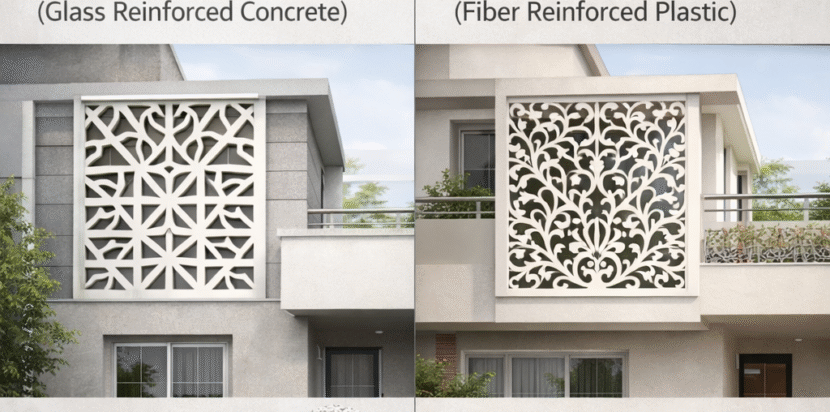
GRC stands for Glass Fibre Reinforced Concrete. It’s a cement-based composite material reinforced with alkali-resistant glass fibres. The end result is something that looks and feels like natural stone or concrete — but is significantly lighter and far more versatile in terms of design possibilities.
You’ve likely seen GRC Jali without even knowing it. Those beautifully crafted decorative screens on the exteriors of luxury hotels, temples, mosques, farmhouses, and high-end residential bungalows? Most of the time, that’s GRC doing its job.
It’s been trusted in construction projects worldwide for decades — and that track record speaks for itself.
What Is FRP Jali?
FRP stands for Fibre Reinforced Polymer. Unlike GRC, FRP is plastic-based — manufactured from synthetic resin combined with glass or carbon fibres. It’s lightweight, easy to handle, quick to install, and generally comes with a lower price tag upfront.
FRP Jali is commonly used for indoor decorative partitions, temporary screens, budget-sensitive projects, and spaces that don’t require the material to withstand outdoor weather conditions.
Both GRC and FRP can be shaped into stunning jali patterns. But beyond the visual similarity, they perform very differently over time — and that’s what really matters.
GRC vs FRP Jali — An Honest Side-by-Side Comparison
| Feature | GRC Jali | FRP Jali |
|---|---|---|
| Base Material | Cement + Glass Fibre | Plastic Resin + Glass Fibre |
| Look & Finish | Natural, stone-like | Smooth, synthetic |
| Lifespan | 50+ years | 10–20 years |
| Weight | Moderate | Very lightweight |
| Fire Safety | Non-combustible ✅ | Can burn or melt ⚠️ |
| UV & Sun Resistance | Excellent | Moderate (fades over time) |
| Weather Resistance | Very High | Moderate |
| Design Flexibility | Very High | High |
| Installation | Requires skilled labour | Fast & easy |
| Upfront Cost | Moderate to High | Low to Moderate |
| Long-Term Value | Excellent | Moderate |
| Best For | Exterior, permanent, premium | Interior, temporary, budget |
Neither material wins across every category. That’s the honest truth. The better choice depends entirely on what your project demands.
When GRC Jali Is the Right Choice
There are certain situations where GRC is simply the smarter, safer, and more practical option. Here’s when you should go with GRC:
When your structure is outdoors. Rain, intense sunlight, humidity, temperature changes — GRC handles all of it without fading, cracking, or warping. For exterior walls, building facades, boundary screens, or courtyard jalis — GRC is built precisely for this kind of exposure.
When you want it to last for decades. A properly installed GRC Jali panel can last 50 years or more with almost no maintenance. You install it once, and it just stays there — looking good and performing well year after year. That’s not just convenient, it’s genuinely cost-effective in the long run.
When fire safety is non-negotiable. This matters more than most people realize at the planning stage. GRC is completely non-combustible. FRP, being plastic-based, can catch fire and release toxic fumes under heat. For public buildings, religious spaces, commercial complexes, or any project governed by fire safety codes — GRC is the only responsible choice.
When you need a premium, natural-looking finish. GRC carries a stone-like texture that integrates naturally into both traditional and contemporary architecture. Whether it’s a Mughal-inspired jaali pattern on a heritage property or a clean geometric screen on a modern home — GRC carries that look authentically and beautifully.
When the project is in a coastal or high-humidity area. Constant moisture, salt air, and tropical heat can degrade FRP panels much faster than most people expect. GRC resists moisture absorption and holds up remarkably well even in challenging climate conditions.
The short version: If it’s going outside, needs to last long, or has any safety requirement attached to it — GRC is the clear choice.
When FRP Jali Is the Right Choice
FRP isn’t a lesser material — it’s just a different one. And for the right situations, it’s genuinely the smarter pick. Here’s when FRP makes more sense:
When it’s an indoor application. Inside a home, office, restaurant, or shopping mall — shielded from direct sun and rain — FRP performs well and looks great. The conditions it struggles with outdoors simply don’t apply in an indoor environment.
When budget is a real constraint. Not every project has a flexible budget, and that’s completely fine. FRP has a significantly lower upfront cost, which makes it a practical choice for smaller projects or decorative features where spending needs to be controlled.
When installation speed matters. FRP panels are lightweight and easy to work with. They don’t require heavy equipment or highly skilled mason work to install. If your timeline is tight and the application isn’t heavy-duty — FRP saves you both time and labour costs.
When the structure is temporary. Exhibition stalls, event setups, seasonal displays, short-term partitions — for anything that isn’t meant to be permanent, investing in GRC simply doesn’t make sense. FRP handles these situations well and at a fraction of the cost.
When the support structure has weight limitations. There are specific scenarios — like lightweight suspended ceilings or delicate interior feature walls — where adding heavy material just isn’t structurally feasible. In these cases, FRP’s low weight becomes a real practical advantage.
The short version: If it’s going indoors, it’s temporary, or the budget is the primary constraint — FRP gets the job done without unnecessary expense.
Not Sure Which One to Pick? Ask Yourself These 3 Questions
Forget what’s trending. Forget what the contractor recommends by default. Just answer these three questions honestly:
1. Where is it being installed — inside or outside? Outside → GRC, without hesitation. Inside → FRP works perfectly well.
2. How long does it need to last? Permanent, long-term structure → GRC. Temporary or medium-term → FRP.
3. What’s the priority — saving money now or getting better value over time? Long-term value → GRC pays off significantly. Tight budget, short-term use → FRP is the smarter spend.
Three honest answers. One clear decision.
Why Choose StoneKingGRC?
If you’ve gone through those three questions and GRC is your answer — the next decision is finding the right manufacturer to trust with your project.
That’s where StoneKingGRC comes in.
We’re not a general construction materials supplier. GRC is all we do — and we do it with a level of focus and expertise that generalist manufacturers simply can’t match.
We specialize in GRC — nothing else. Because our entire operation is built around one material, every panel we produce reflects years of hands-on experience and continuous refinement. You’re getting a product from people who truly know what they’re working with.
Every design is custom-made for your project. Whether you already have architectural drawings ready or need help developing a design from scratch — our team works directly with architects, builders, and homeowners to manufacture exactly what the project needs. Traditional patterns, modern geometric screens, heritage-inspired motifs — all crafted to your exact specifications.
Everything is manufactured in-house. No outsourcing. No middlemen. Every GRC panel is produced under our own roof, which means we maintain complete control over quality at every stage — from raw material selection through to final finishing and dispatch.
We deliver across India. Whether your project is in Delhi, Jaipur, Mumbai, Hyderabad, Bangalore, or anywhere else — we supply pan-India with secure, careful packaging to ensure every panel arrives at your site in perfect condition.
Transparent pricing. No surprises. We believe in straightforward, honest communication. You’ll know exactly what you’re getting, what it costs, and when it will be delivered — right from the start. No hidden charges, no last-minute changes.
We stay with you through the entire process. From the first inquiry to installation guidance — our team remains available and responsive throughout. We don’t just take the order and disappear.
When your project deserves GRC — StoneKingGRC delivers it right.
Comments are closed